Announcing a New Flash Fiction Anthology

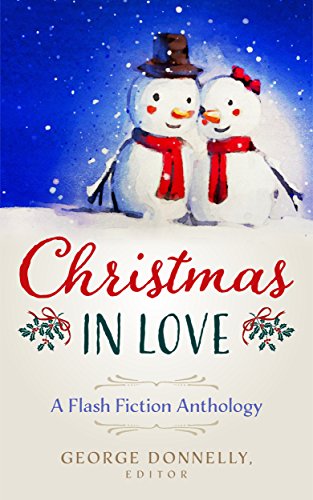
Announcing “Christmas in Love: A Flash Fiction Anthology” edited by George Donnelly and featuring a story by Yours Truly. This new collection of short works is now available on Amazon.

The Kindle version is available FREE for a limited time so act now!

From the description on Amazon.com: https://www.amazon.com/dp/B01MQVG0JL

From an unexpected twist on a classic Christmas tale and a soldier returning home from war to a pair of girls waiting for an unlikely Christmas wish to come true and a creepy evening in a museum, fill your briefest moments with this collection of 18 flash fiction stories.
Commuting to work? Grabbing a quick coffee? Each story tells a complete tale in but a few short minutes with the added promise of a lifelong introduction to new indie writers.
You never know, you might just find your next favorite author.
Christmas in Love, the third anthology in the Flash Flood series, is a hand-picked selection of master works in romance, science fiction and fantasy themed for Christmas and guaranteed to keep you engaged.

If you like Christmas and science fiction, this would be a perfect (and frugal) gift for yourself or friends and family.

Steampunk Holiday Promotion, Part II

ione_telescope

Ione D spies a holiday promotion!

Time marches on. I have long last begun the formatting of Miss Ione D and the Mayan Marvel, my first literary collaboration with Arlys Holloway. Although the novella has been available in e-book format since May, it doesn’t seem quite real to me until I have a paper copy I can hold in my hands. This edition will be supplemented with chapter illustrations by Ben Gill, a very talented local artist we met while working on our play in conjunction with Phoenix Pride.

It’s exciting to take another step toward bringing these stories to life. Someday, perhaps we can find an artist with the time and inclination to work with us on a graphic novel version. For the author, it’s akin to writing a script, complete with scene direction. Artistically, it’s a much larger amount of work, which is why graphic novelists often outsource the inking and shading to a country with lower wage rates. We sure hope the Donald doesn’t find out, or we may be in trouble! Seriously, though, from the comic, it’s a short hop to a full-blown animation, which has always been a dream of mine. How about a score by steampunk luminaries such as Abney Park or Steam Powered Giraffe?

While we do that, we’re also editing the second book in the series, Professor Ione D and the Epicurean Incident, which takes place in London in 1901. Our progress has been slowed a bit by the demands of our day jobs. Hopefully, we will both have more free time after the holidays.

In honor of this next step, we have declared a fiction giveaway contest. No money is required; all you need to do is like and/or share the relevant post as it appears on my Facebook author page today December 4th, or last Sunday’s post (it’s a Steampunk Christmas) in which we first announced it. All who do so between now and December 11th will be entered into a random drawing. First prize is a free novel in paperback form, either my steampunk novel Fidelio’s Automata or my earlier work, Centrifugal Force. There will also be five second prizes of a free e-book download from our works listed on Amazon. For the paperback, we’ll need to have your physical address of course, but don’t worry, we won’t spam you and we never share that information. (Due to the high cost of overseas shipping, US addresses only please!)

https://www.amazon.com/Miss-Ione-Mayan-Marvel-Adventures-ebook/dp/B01G2TBBPU

SCIENCE SATURDAY: Escape from Earth

Earthrise

Earthrise over the Moon, photographed by the Apollo 11 astronauts, from history.nasa.gov

One of the greatest disappointments of my life has been the stalling of space exploration. Considering the rate of the Apollo moon missions in the 1970’s, I expected we’d have a permanent base there by now. Unfortunately, so much of humanity’s resources have been wasted on war, both military and economic, that it’s crippled our efforts to get into space. I believe it will happen eventually, but probably not in my lifetime.

Why should humans go into space? As mountaineer George Mallory said about Everest, “because it’s there.” There are tangible benefits as well, which include scientific discoveries, zero-G manufacturing technology, mining resources in space, and the ability to avert (or survive) a planetary emergency. We’ve already benefited from sending machines into orbit. Satellites for weather, communications, and research have revolutionized our lives.

Because government priorities are driven by the whims of politicians and the fickle attention of the public, NASA and other government agencies are not the answer. The private sector needs to play a major role. Private business in space got off to a slow start, in part to government regulations and the concern that space travel could be weaponized. Since the end of the Shuttle program, and the collapse of America’s Soviet competitor, we’ve seen the birth of a free-enterprise space race. Companies such as Orbital, SpaceX, Blue Origin, Virgin Galactic and dozens of others have taken up the torch.

Even without the burden of government taxation and regulation, the economics of space exploration are still daunting. A 2011 estimate of the cost to get 1 kg of material into low earth orbit was approximately $1000. New technologies such as magnetic rail guns may be helpful (for inert material rather than living things), but escaping the earth’s gravity will remain expensive for a very long time.

The microgravity that makes space exploration so interesting to engineers is also a hazard to the long-term human habitation of space. Rotating space stations are a staple of science fiction because it’s the best way to simulate gravity in orbit. Yet we have not yet created anything of the sort. Once again it’s a matter of resources. To be useful as a human habitation, a rotating station would have to be quite a bit larger than anything we’ve built so far, including the International Space Station. It would also have to be strong enough to stand the stress of constant rotation.

I have hope that mankind will eventually break such barriers. Increased funding to NASA could be a carrot to the aerospace industry as America withdraws from its unproductive interventions abroad. As the US and Russia settle their differences, I look forward to more cooperative ventures between the two countries. But for the most part, the government needs to get out of the way. It’s time for space enthusiasts to put their money where their mouths are and invest in companies that will help us break the shackles of Earth.

If you like the mysteries of space, you’ll enjoy my story Found Pet, available from Amazon: https://www.amazon.com/Found-Pet-Vaughn-Treude-ebook/dp/B018H41FRM

A Pause To Appreciate

arizonascene

We all have different things to be thankful for. The pilgrims, who gathered together in November of 1621, were glad to be alive after a harrowing first year in the New World. Their new friends the Wampanoag were thankful for the land and its bounty, an unspoiled place that still belonged to them. Though we seldom think about Thanksgiving from the Native American perspective, it should remind us all that what the things we love most can easily be lost.

Today, however, on this cool Sunday afternoon, washed clean with the rain, I don’t want to dwell on the negative. In honor of the upcoming Thanksgiving holiday, I’d like to express my thanks for the following:

For free speech in America, still unparalleled in the world.

For all the brilliant writers who have entertained and inspired me.

For the technology that has revolutionized publishing, and the opportunity to express myself as a writer.

For Linux and the free software that allows me to make the most of the creative process.

For lessening tensions between the US and Russia, and hope for lasting peace in the Middle East.

For Arizona, a place that brings together the best of urban life and the natural world.

For the many friends, colleagues and acquaintances over the years, with their different beliefs, faiths, and backgrounds, who have enriched my life.

For my loving family that accepts me despite my numerous quirks.

And for Arlys-Allegra, who is wonderful beyond words.

Life is good!

SCIENCE SATURDAY: Nanotechnology, or Let’s Get Small

2-nanodecoylur

Technology fads come and go as they vie for the attention of our fickle media. One such fad was nanotechnology, the branch of engineering which operates at or near the molecular scale, around 1-100 nanometers in size. In the 1990’s it was the darling of the science media here in America. When the most outrageous predictions didn’t come to pass, the public turned its attention to other topics, such as genetic engineering and space exploration. In reality, nanotech has become part of our lives and thus as invisible to us as water to a fish.

Richard Feynman, a renowned physicist, is credited with the origination of the idea in a talk he gave in 1959, though he did not call in nanotechnology. That term was coined in 1974 by Norio Taguchi, a professor at the Tokyo University of Science. The idea didn’t catch the public imagination until 1986 and the book Engines of Creation: The Coming Era of Nanotechnology, by American engineer K. Eric Drexler. He proposed that manufacturing could be revolutionized by creating nanoscale “assemblers,” tiny machines which could replicate themselves and larger things.

Science fiction writers ran with the idea; a prime example is Neal Stephenson’s award-winning novel Diamond Age (1995), in which nanotech was a positive but disruptive technology. In Kathleen Goonan’s Queen City Jazz (1996) nano-machines run amok, turning whole cities into “gray goo.” An episode of Season 3 of Star Trek the Next Generation (circa 1990) featured a plague of microscopic silicon-based “nanites.” The worry of a nanotech has so far been unfounded. One of the biggest limitations of these tiny machines has been the difficulty of supplying energy at this scale; this has so far kept the doomsday scenarios at bay.

Though the technology doesn’t get nearly as much press these days as it did in the 1990’s, it’s become a critical part of our technology. The website of the US government’s Nano-Technology Initiative lists several widespread uses, most dealing with the creation of micro-electronics. It also mentions bio-engineering applications such as nano-particles that can cure influenza (see artist’s conception above.) Nanotech could eventually provide inexpensive cures for tough diseases such as cancer and HIV, though unfortunately, these are probably years away.

Though public attention is fickle, new ideas such as nano-technology take a considerable time to develop from conception to practical applications. Neither the extravagant promises nor the exaggerated threats of nano-scale engineering have come to fruition. Like all technologies, it has the potential for good or bad. Hopefully, scientists and engineers will make the right choices and allow us to banish diseases such as cancer from the earth.

The above illustration is from http://www.nano.gov/.

If you like small things, you’ll enjoy my short stories such as Fidelio’s Dilemma, available on Amazon.


SELF-PROMOTION SUNDAY: Coming Soon from Ione D

Arlys Endres as Ione D

Arlys Endres as Ione D

I’ve always enjoyed writing, but it’s been more fun since acquiring a collaborator, my amazing friend and partner Arlys Holloway. Though at the time she had little writing experience, she has proved to be a very capable co-author. Our character “Ione D” was her idea, as part of a Facebook campaign she devised to promote my steampunk novel, Fidelio’s Automata. Ione’s name is derived from the middle names of Arlys’ mother and father. I immediately fell for the character and decided that she had to star in her own series.

As a man, writing in first person for a female protagonist has been challenging for me. Arlys has been an incredible help, editing and rewriting my draft dialog from a woman’s perspective. Creating this series was partly a marketing move since these days women dominate the audience of avid readers. Though Ione is quite progressive for her time, to our sensibilities she’s a very old-fashioned and proper girl. We felt this would make Ione a refreshing change for the people of our cynical modern era.

Our first Ione D story, Miss Ione D and the Mayan Marvel, takes place in the 1890’s as the 19-year-old Ione moves with her parents to Guatemala, where her father has been appointed the deputy to the US Ambassador there. There she visits the ancient Mayan ruins of Tikal, makes an amazing discovery, and uncovers a sinister plot. Our second book takes Ione back to London, the city where she spent much of her childhood. She’s attending the first Royal Epicurean Exhibition, a pet project of the new King Edward. His Majesty aims to rehabilitate the image of English cuisine, featuring a fiercely competitive cooking contest. We’ve been working on it diligently and expect to release it early next year.

Another of our projects is to produce a paper edition of the Mayan Marvel book. Since as a novella it is shorter than a typical book, we plan to supplement it by including artwork at the beginning of each chapter. This project will hopefully be completed in early 2017 as well.

I’d like to remind readers that I haven’t given up my plans to publish a sequel of Fidelio’s Automata, called Fidelio’s Insurrection. The Ione D project has delayed my original plans to get to it next year, but I’ll get to that correctly.

Continue to check out my Sunday blog posts for news of another opportunity to win free books and swag from Nakota Publishing (that’s us!)

SCIENCE SATURDAY: Razib Khan and the Controversy of Human Genomics

Razib Khan, scientific outlaw

Razib Khan, scientific outlaw

The science of genetics has added a fascinating dimension to the history of mankind. For example, we once thought that Neanderthal people went extinct. Now scientists believe that modern humans have Neanderthal genes, meaning that our ancestors got close and personal with their caveman cousins. It’s also fascinating to consider when humans first occupied what parts of the earth, and in what direction they migrated. New theories have provoked fierce debate about migrations to places like Australia and the Americas earlier than experts previously believed. Genetic analysis of human remains is one piece of this puzzle. Why is this branch of science not more popular than it is? I suspect the reason may be political.

For the last few months, I’ve been reading the Gene Expression Blog by Razib Khan at the alt media site unz.com. I’ll write more about that excellent site in an upcoming blog post. Khan is an avid reader and a prolific writer on evolution, history, religion, and philosophy. He also writes frequently about the field of personal genomics and controversial services such as 23andMe. Khan’s profile lists him as a graduate student in genomics at UC Davis. His column has renewed my dormant interest in human genetics and paleo-history.

The problem is, Khan doesn’t stick to the narrative. He engages with publications and groups that are politically incorrect. Last year the New York Times booted him off the editorial pages for that reason. The gossip site gawker.com had outed him for his association with allegedly “racist” sites takimag.com and vdare.com. That’s their loss and Unz’s gain. It gives me great satisfaction, however, that VDare and Taki’s Magazine are still going strong, but Gawker is no more.

It’s appalling to think that a smart, well-spoken fellow like Khan would be punished for his associations. I’m reminded of how the Catholic Church treated Galileo’s theories. Yes, many biologists speculate on the differences between human racial groups concerning average intelligence, health, stamina, etc. This may offend politically correct opinion. Yet I don’t think that scientists actually believe the propaganda that “race is an illusion” and that all groups are exactly equal in potential. If you think about it, the egalitarian view is counter-intuitive. As a progressive friend commented to me, concerning the differences between ethnicities, “Why would you think they’d all be the same?”

My point is that science shouldn’t make value judgments. Research gives us information, which we can use for good or evil, to help people or hurt them. You may ask, what good does it do for us to know how and where humans originated, and the differences between racial groups? We don’t know. Neither did the Pope Urban VIII at the time he censured Galileo. He couldn’t have foreseen space exploration and its benefits, yet his closed-mindedness could have prevented all of that.

Arlys’ and my book Miss Ione D and the Mayan Marvel takes a fanciful look at Mesoamerican paleontology. Check it out at https://www.amazon.com/Miss-Ione-Mayan-Marvel-Adventures-ebook/dp/B01G2TBBPU/

FREE SPEECH FRIDAY: Honoring an American Hero

smedleybutler-jpeg

“There are only two things we should fight for. One is the defense of our homes and the other is the Bill of Rights.”

— General Smedley Darlington Butler

On this Veteran’s Day, I’d like to remember one of America’s most decorated veterans, Marine Corps Major General Smedley Butler. He was one of 19 men to be awarded the Medal of Honor twice. He was also one of America’s bravest truth-tellers, author of the 1935 classic War is a Racket. This book is available in digital form on Amazon for 99 cents.

Butler participated in American military actions in several countries, including the first World War. He did not become outspoken until after his retirement. One of his most controversial actions was coming to Congress with information about the so-called Business Plot, a conspiracy to overthrow President Franklin Roosevelt and replace him with a military dictator. All the alleged conspirators denied it, of course, but a Congressional committee verified at least some of his testimony.

I highly recommend reading Butler’s book. It’s quite short and can be read in a few hours. Though written shortly before WWII, it nevertheless seems to mirror current events, as Butler writes about all the extravagant profits earned by various “patriotic” industries, from steel to leather (for cavalry saddles.) He also condemns the use of the US military as an enforcer for corporate interests in other nations, such as United Fruit Company’s abusive, monopolistic practices in Central America.

Butler didn’t live to see the second World War that he was warning the nation about. He died of cancer in 1940 at the age of 58. Besides “War is a Racket”, he wrote books about military actions in Mexico and Paraguay. Some of his speeches and letters have also been compiled and published. One of his co-authors was Arthur J. Burks, a marine colonel and a fascinating character in his own right. Burks wrote numerous books and stories in the adventure, detective, and sci-fi genres.

If you’re an admirer of Smedley Butler, you’ll enjoy my political sci-fi novel Centrifugal Force, because he’s mentioned in it.

Time Travel Thursday – The Wild Wild West

180px-ross_martin_robert_conrad_wild_wild_west_1965

Ross Martin and Robert Conrad as Gordon and West

In this year of Star Trek’s 50th anniversary, I’d like to call attention to another pioneering series: The Wild Wild West. In my childhood, it was my second favorite show. For those of you who are too young to remember, it was a historical drama created by Michael Garrison, set during the 1870’s and starring Robert Conrad and Ross Martin as Jim West and Artemis Gordon, dashing Secret Service agents. I loved it for the gadgetry and its science fiction elements. Its fanciful treatment of America’s past has caused many steampunk aficionados to declare it a forerunner of their favorite genre.
West and Gordon had the coolest ride, which doubled as their headquarters: their own private train, which included a laboratory and a stable. It had great villains, too, particularly the Spanish dwarf Dr. Miguelito Loveless, played by Michael Dunn. An evil genius, he invented the airplane, the cathode-ray tube, and an LSD-like drug. Another thing I enjoyed about the show was the animated title sequence, a montage which showed a heroic cowboy fighting the bad guys and kissing the girl. At the commercial breaks, they would replace each of these pictures with a scene from that episode.
I didn’t know this, but the show’s Wikipedia article notes that the series was canceled not due to bad ratings but because of the outcry over “television violence.” Was that the real reason, or was it political correctness that pushed the Western genre off of television? It’s not a scientific study by any means, but I seem to remember cowboy shows as being less violent than the 1970’s crime dramas that replaced them. The Wild Wild West, with its campy James Bond light-heartedness, did not deserve this early death.
Many of my younger readers may recall the feature film version which was made in 1999, starring Will Smith and Kevin Kline as Agents West and Gordon, with Salma Hayek as the damsel in distress. Sadly, its quality wasn’t up to that of the series, earning only 17% on Rotten Tomatoes. Though I’m a big fan of Smith, it seemed strange to have a black man as a Federal agent so few years after the 13th Amendment abolished slavery. Then again, it’s steampunk; anything can happen.
Another plot element that changed in the movie was that West and Gordon’s nemesis changed. The scheming little person became an embittered Southern amputee, Dr. Arliss Loveless. The PC anti-Confederate message was obvious, though at least they gave him a cool name.
DVD’s of the original series are available for rent on Netflix or for purchase on Amazon. Unfortunately, I haven’t been able to locate it in streaming form.

If you like steampunk cowboy adventures you’ll love my book Fidelio’s Automata on Amazon.

Photo is from Wikimedia Commons.


WRITERS’ WEDNESDAY: Writing for the Theater: A Horse of a Different Color

Theater Masks

Something appealing, something appalling…

When I joined a theater group a few years ago, I already had experience writing novels and stories. The transition was not as easy as I’d expected. Although a novel can be adapted to a script and vice versa, the two are different art forms. At the time I decided it would be easier to create a new work. I remembered stories my girlfriend Arlys had told me of her weird on-line dating experiences, and voila, a musical comedy was born! I’ll save the rest of that story for an upcoming Self-promotion Sunday post.

The first rule of script writing is that your audience – producers, directors, and actors – expect it to be in a specific format. Using a word-processor template can make this easy. There’s a reason for using the archaic Courier font: it helps keep the timing consistent. As a rule of thumb, a page of dialog should last a minute on stage, but in practice that can vary greatly.

Secondly, converting standard prose to script can be challenging. Your pretty description and narrative must be replaced with scene and stage direction, which should be as concise and utilitarian as possible. How thorough you make these directions is a matter of personal style. Some famous playwrights, such as Pinter, use almost none. In any case, you will surrender much of your creative control to directors, actors, and set designers.

This conversion will be easier if you follow the cardinal rule of good writing: show don’t tell. In the theater, the writer shows through dialog and action. A good set can be helpful, but a play can be just as effective on a bare stage. If necessary, a character can play the role of a narrator, but this device should be used sparingly.

Comedy is a difficult genre in any form because humor is a personal thing. Unless you’re a natural, I suggest writing comedy with a co-author. The social dynamics of collaboration will help you come up with better, funnier jokes.

Music adds another layer of complexity. It’s good to have a song occur early in the scene, for maximum impact. Of course, the flow of the dialog will determine the ideal place for a song to occur.

Theater writing has its positive aspects, of course. Even if it’s not your primary mode of expression it’s a good exercise. It incorporates a social element that the solitary habit of writing normally lacks. Larger cities often have showcases for local talent, and they’re always looking for new works. These provide good opportunities for publicity and increased name recognition.

In this short post, I’ve barely scratched the surface of this topic. My primary message is not to underestimate the challenge of writing for the theater, but also to point out its potential rewards. As the saying goes, there’s no business like show business!

For some dramatic storytelling, check out my books on Amazon.com.